
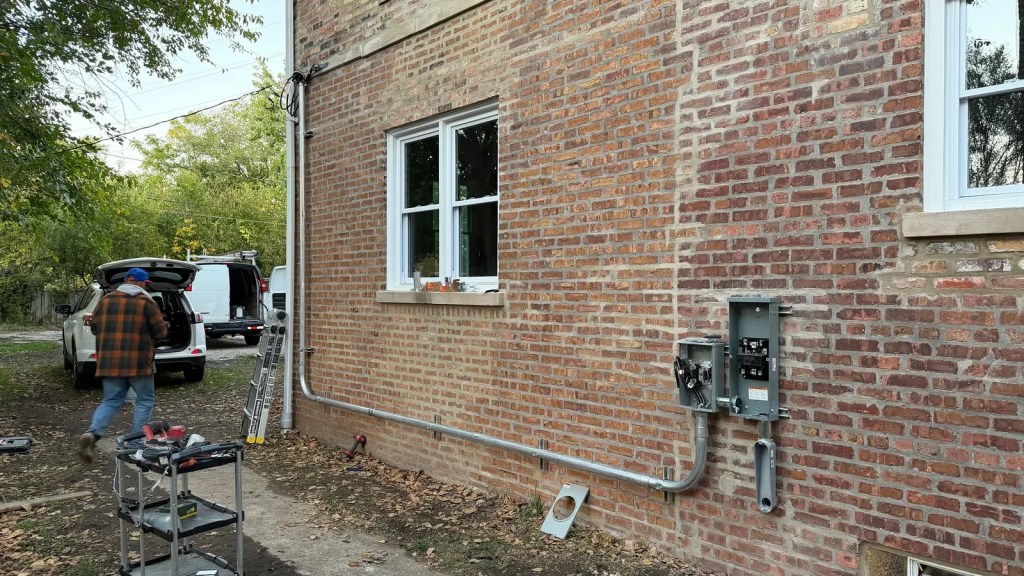
Lighting street lighting
Most lighting complaints are about the wrong light in the wrong place, not the bulb. Quik Wire Electric handles street lighting across Des Plaines and 24 Illinois counties. Licensed, insured, permitted where it needs to be.
- Licensed
Illinois electrical contractor license. The work passes inspection.
- Insured
Full coverage on every job, residential through municipal.
- 24/7
No power, burning smell, breaker that will not hold. We answer.
- Permits pulled
Permit paperwork and the inspector’s visit are handled by us, wherever required.
What street lighting involves
Most lighting complaints are about the wrong light in the wrong place, not the bulb. The work starts with finding out what is actually there. With street lighting, that means looking at the existing wiring, the panel capacity and whatever the last person left behind.
We explain the job in plain terms before anything starts: what we are changing, why, and how long the power will be off. If a smaller fix does the job, that is the fix you get.
Where this comes up
Interior, exterior, parking lots, athletic fields and the controls that run them. Most of these calls come from Des Plaines and the surrounding suburbs, but we take them anywhere in our service area.
Previous work is the wild card. Plenty of Illinois homes and shops have circuits somebody extended on a weekend, splices buried in a wall with no box, and breakers upsized to stop a nuisance trip. We find those first, because they decide what is safe to build on.
How we do it
We work like it is our own house. Drop cloths go down, the power stays off only as long as it has to, and the work is finished to code with the permit closed out where the village requires one.
Why this is worth doing properly
A bad electrical connection does not fail politely. It heats, it chars the box around it, and eventually starts a fire inside a wall where nobody can see it. That is why the licensing exists and why an inspector looks at the work. Every connection has to be tight, every conductor sized for the load it will actually carry, every box accessible afterwards.
The cost of doing it right the first time is almost always lower than the cost of doing it twice. We would rather tell you the job is bigger than you hoped than come back in two years.
Scheduling and how long it takes
We answer 24/7 and an emergency gets a crew the same day. Planned work typically starts within a few days of the go-ahead, unless a permit or a ComEd appointment has to land first.
Some dates are ours to set and some belong to somebody else. The install day is ours. The village inspection and any ComEd disconnect are not, so we book those first and build our part of the schedule around them.
What the permit actually buys you
A permit puts the work on the public record for the address. When the building changes hands, that record is evidence the electrical was done and checked. Without it, a buyer's inspector treats everything they find as suspect.
It also means the work was sized and installed to the code edition in force, not to whatever was normal when the building went up.
Copper, aluminum and what is in your walls
Aluminum branch wiring went into a lot of houses in the late sixties and early seventies. It is not automatically dangerous, but it expands and contracts more than copper, which loosens terminations over time, and it needs devices and connectors rated for it.
The repair is usually not a full rewire. Proper connectors at every termination, done thoroughly, solves most of it. Anybody quoting you a whole-house rewire on sight has not looked.
The warning signs people ignore
The breaker that trips once a month gets ignored because it holds afterward. The outlet that only works when the plug is wiggled gets a strip of tape over it. Both are connections failing slowly. Slow failures give you time, but they do not fix themselves.
A faint smell that comes and goes is worth a call. Overheating insulation gives off that smell well before anything is visibly scorched.
Lighting is a wiring problem first
Most lighting complaints are not about the fixture. They are about how many circuits are available, where the switches are, whether the dimmer matches the driver in the lamp, and whether the boxes can carry the weight of what is going on them.
Retrofitting LED into fittings designed for incandescent introduces its own issues, usually flicker or buzz from a dimmer that was never meant for an electronic load.
We tell you what is wrong before we tell you what it costs.
How the job runs
- Step 1
Call
An electrician picks up. Describe what you are seeing and we will tell you how urgent it is.
- Step 2
Diagnose
We find the actual fault. Not a guess, and not a rewire you did not need.
- Step 3
Price
You get the number before the work starts, in writing.
- Step 4
Permit
Where the village requires one, we pull it. That is on us, not on you.
- Step 5
Install
Licensed and insured, to code, cleaned up behind us.
- Step 6
Inspect
We meet the inspector and we sign off. You get the documentation.
Other lighting work
Related services we handle with the same crew.
- Lighting commercial lightingInterior, exterior, parking lots, athletic fields and the controls that run them.
- Residential lightingInterior, exterior, parking lots, athletic fields and the controls that run them.
- Municipal lightingInterior, exterior, parking lots, athletic fields and the controls that run them.
- Government lightingInterior, exterior, parking lots, athletic fields and the controls that run them.
- Lighting LED lightingInterior, exterior, parking lots, athletic fields and the controls that run them.
- Lighting LED retrofitsInterior, exterior, parking lots, athletic fields and the controls that run them.
- Lighting interior lightingInterior, exterior, parking lots, athletic fields and the controls that run them.
- Lighting exterior lightingInterior, exterior, parking lots, athletic fields and the controls that run them.

Street lighting, done on the record
Done to code by a licensed electrician, covered by our insurance, and signed off by the inspector wherever a permit applies.
Street lighting questions
Do you handle street lighting in Des Plaines?
Yes. Street lighting is work we do regularly out of our Des Plaines shop, and we cover 24 counties across Illinois. Call and we will tell you when we can be there.
Is the work permitted and inspected?
Yes, whenever the job calls for it. We file the permit with the village or city, schedule the inspection and are there when the inspector arrives. The paperwork comes to you at the end.
How soon can you start?
When you call, we tell you where you fall. Emergencies are same-day. Most scheduled jobs start within a few days, and if a permit or parts will slow things down, you hear that up front.
Are you licensed for this?
Yes. We carry an Illinois electrical contractor license and insurance, and you are welcome to ask for proof of both before any work starts.
What does it cost?
That depends on the scope, and the scope depends on what we find when we open things up. We look first, then put a written number in front of you before anything starts. You decide from there.
Where we work
We cover 527 municipalities across 24 counties.
- Des Plaines, ILStreet lighting in Des Plaines and the rest of Cook County.
- Northbrook, ILStreet lighting in Northbrook and the rest of Cook County.
Need street lighting?
Call (224) 245-6038. You get an electrician, not a call center.
Not sold yet? Browse the jobs we have finished, then send over what you need wired.