

Housing stock in this part of Illinois spans about a century of wiring practice, and you can read the decade off what is behind a switch plate. None of it is automatically dangerous. All of it changes what a remodel costs.
Knob-and-tube
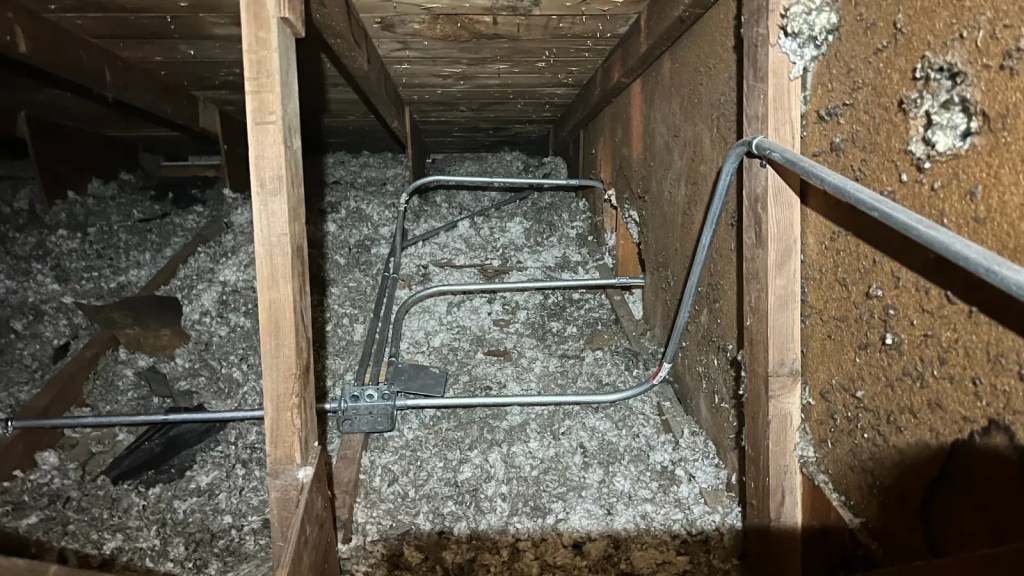
The oldest of it. Conductors run separately through porcelain, with no ground. It was competent work for its time and a lot of it is still intact. The problems are that it has no ground path, that its insulation gets brittle, and that it was never meant to be buried in blown-in attic insulation, which traps heat around it.
Cloth-insulated cable
Post-war, usually two-wire and ungrounded. That is why half the outlets in a house like this are two-prong and the other half were swapped to three-prong by somebody who should not have. A three-prong receptacle with no ground behind it is a lie that a tester will catch in seconds.
Aluminum branch wiring
Late sixties into the seventies. It gets a worse reputation than it deserves. It is a metal that moves more than copper does, so terminations loosen over years of heating and cooling. That is the actual failure mode and it is a slow one.
Proper connectors rated for aluminum at every termination, done thoroughly, handles most of it. Anybody quoting you a whole-house rewire without opening a single device box has not looked.
When a rewire is the right call
Gut rehabs, additions where the walls are open anyway, and houses where the existing wiring genuinely cannot support how the place is used. Outside those, targeted work usually gets you further for less disruption.
What an inspector will flag
- Three-prong receptacles on ungrounded two-wire circuits.
- Buried junctions with no accessible box, usually found during a remodel.
- Neutrals and grounds bonded in a subpanel, which puts current on metal people touch.
- Knob-and-tube buried in blown-in attic insulation, which traps heat around it.
- Overfilled boxes and backstabbed devices on aluminum conductors.
None of that is visible from the living room. It surfaces during a remodel, a home inspection, or the day a breaker stops holding.
What it costs you to leave
Mostly, it costs you at the worst moment. Unpermitted or non-compliant electrical becomes a negotiating point during a sale, an insurance question after a claim, and an unplanned line item in the middle of a kitchen remodel when the walls are already open and the cabinets are on order.
The sensible order to do it in
Deal with anything actively unsafe first: ungrounded three-prong receptacles, buried junctions, a subpanel bonded wrong. Then handle the rest opportunistically, when a wall is open for another reason. A whole-house rewire is the right call during a gut rehab and an expensive way to solve a small problem otherwise.
Questions we get about this
Is knob-and-tube dangerous?
Not inherently. It was competent work and a lot of it is intact. The problems are that it has no ground path, its insulation embrittles, and it was never intended to be buried in blown-in insulation, which traps heat around it.
Does aluminum wiring mean a full rewire?
Almost never. The failure mode is loosening terminations, and proper connectors rated for aluminum at every device handles most of it. Anybody quoting a whole-house rewire without opening a device box has not looked.
Will my insurer care?
Some ask about knob-and-tube and aluminum branch wiring specifically. Documented remediation with a permit and closed inspection is what satisfies them.
When is a rewire genuinely right?
Gut rehabs, additions where walls are open anyway, and houses where the wiring cannot support how the place is used. Outside those, targeted work gets you further for less disruption.
How we price and schedule this
We look before we quote. That means somebody comes out, opens the panel, and finds out what is actually behind the wall. Quoting a job like this over the phone produces a number that changes, and a number that changes is worse than no number at all.
What you get is written, itemized against a defined scope. If we open something up and the scope genuinely changes, we stop and tell you before carrying on. Emergencies get same-day attention; scheduled work usually starts within a few days, though anything needing a permit or a utility disconnect runs on the village calendar and ComEd’s as well as ours. We will tell you at the quote which parts we control and which we do not.
What done looks like
The work gets tested, the circuits get labeled properly in the panel, and the site gets cleaned up behind us. Labeled panels matter more than people think, because the next person working on that system is reading your labels to decide what is safe to touch. Where a permit was pulled you get the closed inspection, and where documentation exists, you get it.
Why the permit and the inspection matter here
Illinois municipalities adopt the National Electrical Code on their own schedule, so the rules in one village are not always the rules in the next one over, and permit thresholds differ too. Some places want a permit for a single new circuit; others only for a service change or a panel replacement. We deal with whichever jurisdiction the job sits in rather than guessing, which is part of what you are hiring.
The inspection is not a formality to get through. It is an independent check that what went behind the drywall matches what was supposed to, carried out by somebody with no stake in the invoice. It also puts the work on the public record for the address, which is what a buyer, a buyer’s inspector or an insurer will eventually ask about.
Who does the work
Quik Wire Electric is a licensed Illinois electrical contractor and we carry insurance on every job. Where the village requires a permit we pull it and we meet the inspector, so the work goes on the public record for the address rather than living only in your memory.
The same licensed electricians turn up whether the job is one dead outlet in a bungalow or switchgear in a village facility. We do not run a separate B-team for small work and we do not subcontract the parts nobody wants. You get told who is coming and roughly when, and if we are running late you get a call.
We work out of Des Plaines and cover 24 Illinois counties, from Cook and Lake through DuPage, Kane, McHenry and Will and out to Winnebago, LaSalle and Champaign. The full service area is here if you want to check whether your address is on it.
Older house in Belvidere? knob-and-tube replacement in Belvidere explains how the work is staged in a home somebody is living in.
Want to know what is in your walls?
We can tell you a lot from a few device boxes and the panel, without opening the place up.
Talk to an electrician