
A panel upgrade is one of the bigger electrical purchases a homeowner makes, which is exactly why it gets sold to people who do not need one. The honest version of this conversation starts with arithmetic, not with a look at the age of your panel.
Age alone proves very little. A well-installed 1970s panel with room in it and tight terminations can be in better shape than a crowded ten-year-old one. What decides the question is whether the service can carry the load you actually put on it, and whether the equipment itself is sound.
The load calculation is the whole answer
Code gives a method for working out what a dwelling actually demands: the square footage, the fixed appliances, the heating and cooling, and then a set of demand factors because you never run everything at once. That number tells you whether a 100-amp service carries what you have. Frequently it does.
Where it stops working is when big continuous loads arrive. An EV charger is the common one, because code requires the circuit sized at 125 percent of its rating. Add a heat pump on top of that and the math usually runs out.
Signs that are worth a call
No spaces left and tandem breakers doubled up in slots that were not listed for them. Rust or water staining inside the enclosure. A panel that is warm to the touch. Lights that dim noticeably when the air conditioning starts. Any brand with a known failure history, which an electrician will recognize on sight.
A subpanel is often the cheaper, faster answer when the SERVICE is adequate but the panel is simply full. It is worth asking which one you actually need before being quoted the larger job.
Panel, service, or both
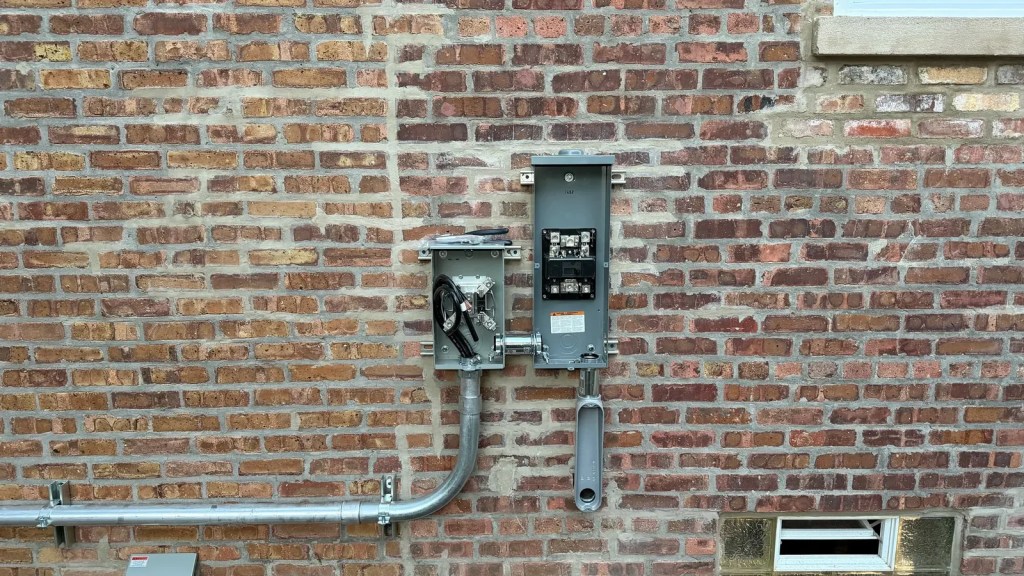
These get used interchangeably and they are different jobs at very different prices. The service is everything from the utility to your meter and main disconnect: the mast, the weatherhead, the conductors, the meter socket. The panel is the distribution equipment inside. You can replace the panel without touching the service, and that is often the right answer when the service is adequate but the panel is simply full or obsolete.
A subpanel is the third option and the one people are rarely offered. If the service carries the load and you just need more spaces, feeding a subpanel from the existing main is cheaper and faster than a full service change.
- The calculated load, not just the existing service size.
- Whether the service or only the panel is being replaced.
- Whether a subpanel would solve it for less.
- Who coordinates the utility disconnect and who files the permit.
- What happens to the grounding electrode system, which frequently needs bringing up to current code at the same time.
What the work involves
A service change means coordinating a utility disconnect and reconnect as well as the village inspection, so it runs on two calendars rather than one. Power is off for a stretch of the day, which is worth planning around if somebody works from home or there is medical equipment in the house.
We pull the permit, meet the inspector, label every circuit properly in the new panel, and you get the closed inspection at the end. Labelled panels matter more than people think, because the next person working on that system is reading your labels to decide what is safe to touch.
Sometimes the honest answer is that your service carries it and you do not need us.
Questions we get about this
How do I know if my 100-amp service is enough?
Through a load calculation, which is a defined code method: square footage, fixed appliances, heating and cooling, then demand factors because you never run everything at once. Plenty of 100-amp services carry a modern household fine. Where it runs out is when two large continuous loads arrive.
How long is the power off?
For a service change, most of a working day. The utility disconnects, we do the work, the inspector comes, the utility reconnects. We tell you the window in advance.
Do I need a permit for this?
Yes, everywhere we work. A service change is exactly the kind of job permitting exists for. We pull it and meet the inspector.
Will a subpanel do instead?
Often, and it is cheaper. If the service carries the load and you simply need more spaces, a subpanel fed from the existing main solves it.
How we price and schedule this
We look before we quote. That means somebody comes out, opens the panel, and finds out what is actually behind the wall. Quoting a job like this over the phone produces a number that changes, and a number that changes is worse than no number at all.
What you get is written, itemized against a defined scope. If we open something up and the scope genuinely changes, we stop and tell you before carrying on. Emergencies get same-day attention; scheduled work usually starts within a few days, though anything needing a permit or a utility disconnect runs on the village calendar and ComEd’s as well as ours. We will tell you at the quote which parts we control and which we do not.
What done looks like
The work gets tested, the circuits get labeled properly in the panel, and the site gets cleaned up behind us. Labeled panels matter more than people think, because the next person working on that system is reading your labels to decide what is safe to touch. Where a permit was pulled you get the closed inspection, and where documentation exists, you get it.
Why the permit and the inspection matter here
Illinois municipalities adopt the National Electrical Code on their own schedule, so the rules in one village are not always the rules in the next one over, and permit thresholds differ too. Some places want a permit for a single new circuit; others only for a service change or a panel replacement. We deal with whichever jurisdiction the job sits in rather than guessing, which is part of what you are hiring.
The inspection is not a formality to get through. It is an independent check that what went behind the drywall matches what was supposed to, carried out by somebody with no stake in the invoice. It also puts the work on the public record for the address, which is what a buyer, a buyer’s inspector or an insurer will eventually ask about.
Who does the work
Quik Wire Electric is a licensed Illinois electrical contractor and we carry insurance on every job. Where the village requires a permit we pull it and we meet the inspector, so the work goes on the public record for the address rather than living only in your memory.
The same licensed electricians turn up whether the job is one dead outlet in a bungalow or switchgear in a village facility. We do not run a separate B-team for small work and we do not subcontract the parts nobody wants. You get told who is coming and roughly when, and if we are running late you get a call.
We work out of Des Plaines and cover 24 Illinois counties, from Cook and Lake through DuPage, Kane, McHenry and Will and out to Winnebago, LaSalle and Champaign. The full service area is here if you want to check whether your address is on it.
For a Boone County address, our Belvidere panel upgrade page covers the load calculation, the ComEd disconnect and the city inspection a service change needs.
Not sure whether your panel has room?
We run the load calculation before quoting anything. Sometimes the answer is that you do not need us.
Talk to an electrician